
The Stakapal Guide to Cantilever Racking
Across the UK, warehouses, builders’ merchants, and timber yards all face a similar challenge: how to store long, bulky materials efficiently and safely. Whether it is planks of timber, metal tubing, steel profiles, or sheet materials, traditional pallet racking just does not cut it.
That is where cantilever racking comes in. Designed to handle heavy and awkward loads with ease, cantilever systems are the go-to solution for storing items of varying lengths and weights.
In this guide, we will explore everything you need to know about cantilever racking in the UK, what it is, how it works, the different types available, materials and finishes, installation and safety tips.
By the end, you will know exactly how to choose, configure, and buy cantilever racking suited to your business needs.
What is Cantilever Racking & How Does it Work?
Cantilever racking is a specialist storage system designed for long, heavy items that cannot be stored on standard pallet racks.
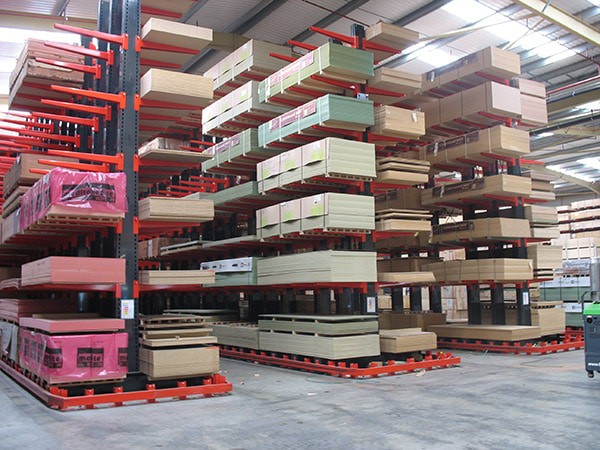
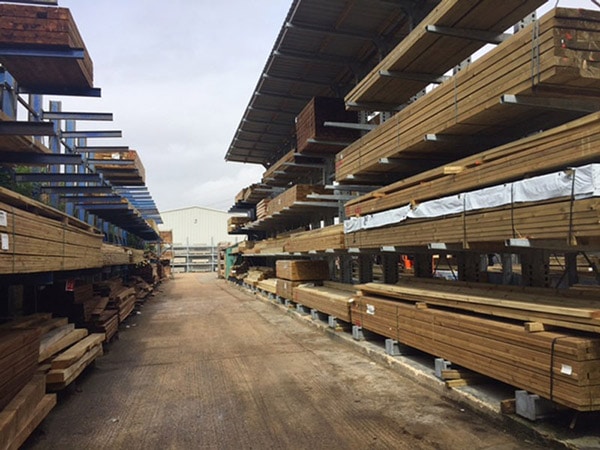
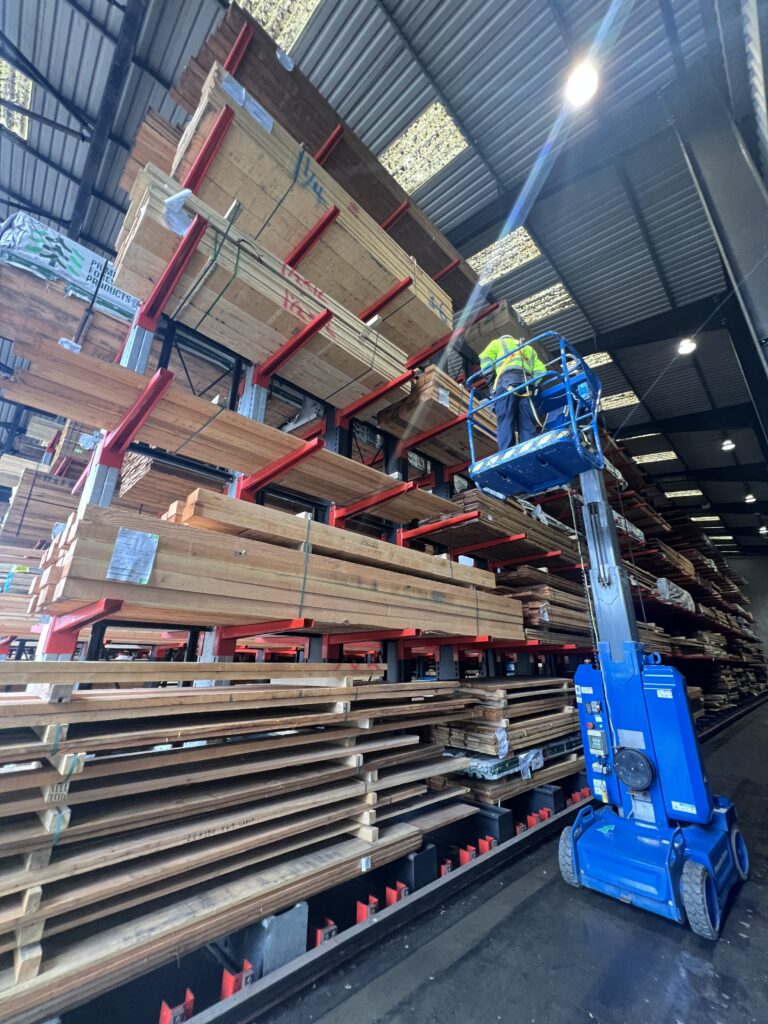
Each system is built around vertical steel columns with horizontal arms that extend outward, much like shelves without front posts. The absence of front uprights means forklifts or side-loading trucks can access materials directly from the front, making loading and unloading fast and efficient.
What Are The Main Components of Cantilever Racking
A cantilever racking system consists of several key components that work together to create a safe and stable storage solution.
The base and footplate anchor the system securely to the floor, ensuring stability under heavy loads.
The vertical column, or upright, carries the vertical and bending loads, providing the main support structure.
Cantilever arms extend outward from the columns to bear the weight of stored items, while the bracing add lateral stability and prevent sway.
Optional features such as end stops can be added to stop materials from rolling or sliding off the arms, enhancing safety and organisation.
The cantilever design efficiently transfers loads from the arms into the column and down through the baseplate into the floor. Because there are no front uprights, materials of varying lengths can be stored along one continuous level, making it an ideal choice when you buy cantilever racking for timber, piping, or steel storage.
Types of Cantilever Racking
Conventional Cantilever Racking
The most common type, ideal for standard warehouse or yard storage.
- Open-aisle design for easy forklift access.
- Available as single-sided (against a wall) or double-sided (accessible from both sides).
- Perfect for timber, sheet materials, piping, and panels.
Best for: Timber merchants, manufacturing plants, and general industrial storage.
When you buy cantilever racking of this type, it provides maximum flexibility and long-term scalability for your growing inventory.
Guided-Aisle Cantilever Racking
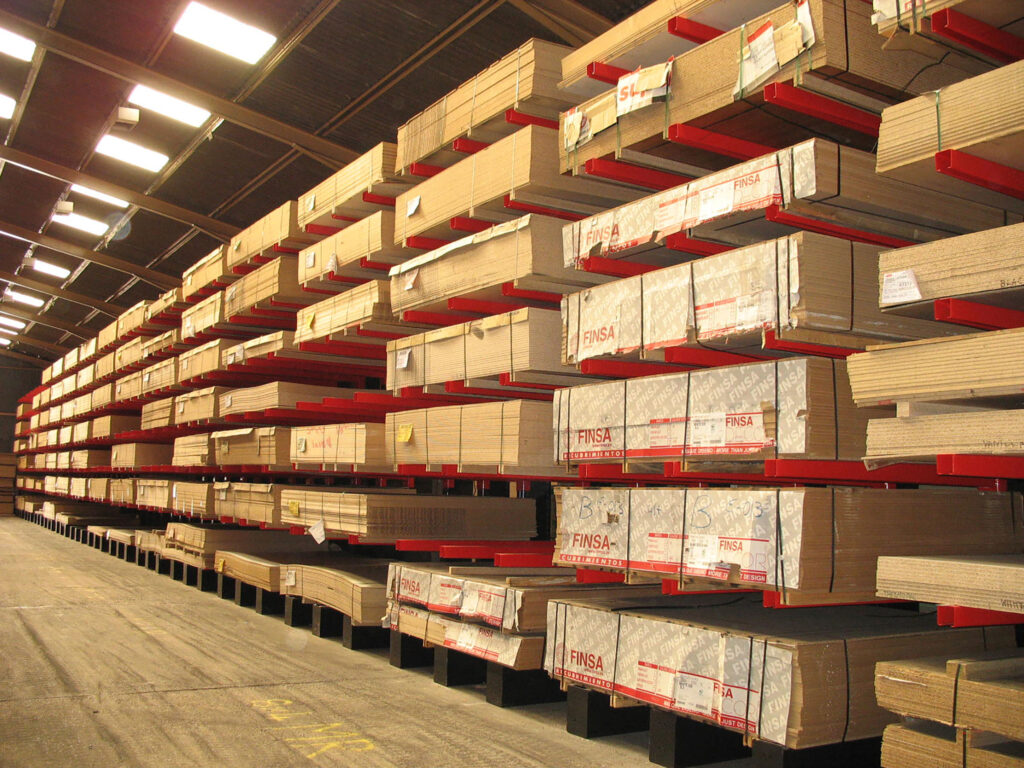
Designed for tighter warehouse layouts, this system uses in-floor or rail guides to keep forklifts aligned when operating in narrow aisles.
- Increases storage density by reducing aisle width.
- Enhances operator safety and precision.
- Requires accurate floor preparation and specialist trucks.
Best for: High-density storage applications where space is at a premium.
Free-Path Cantilever Racking
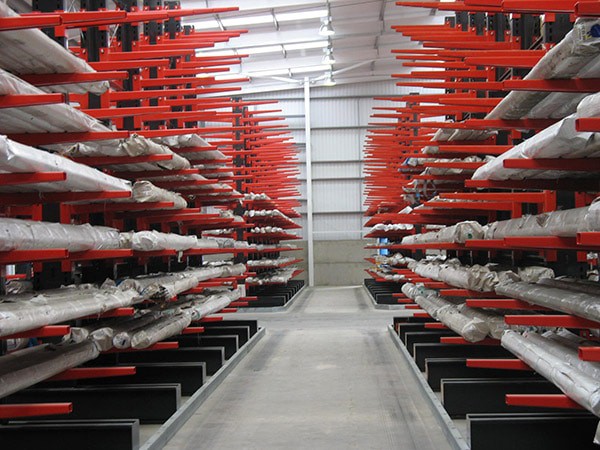
For advanced operations, automated or semi-automated guided trucks can move within specially designed cantilever aisles.
- Reduces human error.
- Improves retrieval speed and accuracy.
- Higher upfront cost, but ideal for large distribution centres.
Best for: Large-scale timber distribution, metal fabrication, or manufacturing facilities that are looking to buy cantilever racking to modernise and future-proof their storage systems.
Materials and Finishes
The material and finish of your cantilever racking system have a big impact on its performance, durability, and suitability for specific environments.
Material
The material and finish of your cantilever racking system play a crucial role in its strength, durability, and suitability for different environments. Locally sourced steel is the standard material used in Stakapal racking, offering excellent strength and resilience.
Finishes
When it comes to finishes, powder coating provides a smooth, durable surface ideal for indoor environments. Hot-dip galvanising is recommended for outdoor or damp conditions as it protects the steel from corrosion.
All Stakapal Cantilever Racking Systems are manufactured in the UK, SEMA-approved, and SEIRS-installed, ensuring long-term safety and compliance.
A proper installation is essential to ensure safety, performance, and compliance. Stakapal’s SEIRS-qualified installation team follows a strict, step-by-step process. The process begins with a site survey to assess the slab condition and layout.
Next, columns are installed and securely anchored using bolts. Once in place, the arms and bracing are fitted and precisely levelled to ensure it is aligned correctly.
Finally, a series of checks and tests are carried out, and load signage are carried out to confirm full compliance with SEMA standards. A correctly installed system guarantees reliability and inspection readiness.
Maintenance and Safety Checks
Regular inspections are vital for keeping your racking system safe and compliant.
Monthly or Quarterly Checks:
- Look for bent or damaged arms.
- Check for loose bolts and baseplates.
- Confirm racks remain plumb and level.
Annual Inspection:
All racking systems should undergo a SARI-approved inspection annually.
Book your next Racking Inspection with Stakapal. Regular maintenance helps protect your investment when you buy cantilever racking for long-term use.
So, Should You Buy Cantilever Racking?
Cantilever racking offers a flexible, space-efficient, and robust solution for storing long or bulky materials, from timber and sheet goods to steel profiles and pipes.
As a UK manufacturer and SEMA Full Member, Stakapal designs, fabricates, and installs bespoke cantilever racking systems tailored to your exact needs, not to mention offering annual inspections for our racking to ensure your racking performs at its best. Whether you are upgrading a small timber yard or managing a large warehouse, now is the perfect time to buy cantilever racking that delivers performance, safety, and scalability.

Buy Cantilever Racking - FAQs
It really depends on the Timber product you are storing. Typically, conventional or guided-aisle cantilever racking systems are used, but it all depends on your available space and forklift truck access. That is why Stakapal offer free site visits to help you determine the best racking configuration for your business and product. Contact us here.
Yes, cantilever racking can truly help you make the most of available space, including outdoors! Be careful, though and ensure that any racking that is going to be used outdoors is professionally galvanised to protect it from corrosion when exposed to the elements.
Find more information about our cantilever racking here.
Buying directly from the manufacturer is always your best bet; you are guaranteed the best price and knowledge from the people who have hands-on experience of the product from concept to completion.
Choosing Stakapal also means we design, manufacture, supply and install everything from our Midlands purpose-built facility (and we are the only UK manufacturers of both cantilever and pallet racking). We also offer Expert Inspections with five in-house SARIs who can inspect all types of racking. Contact us here.
The amount of traffic in your warehouse usually determines how often racking should be inspected; more traffic equals more frequent inspections. This is usually decided by a PRRS.
Any damage should be reported immediately to a PRRS and acted upon in an appropriate manner.
Formal Expert Inspections must be undertaken annually (at least every 12 months) by a "technically competent person" such as a SARI. Click the link for more information about racking inspections, or to book one with our in-house SARIs, contact us.
You can absolutely do that! For situations like this, we always recommend that the internal racking be galvanised as it makes it well equipped for when it gets moved outside.
Relocating dismantled racking should always be done by a SEIRS qualified installer and may be subject to an inspection by the manufacturer. Check out this guide on racking installation and relocation.
EXCELLENT Based on 21 reviews
 Posted on Google
 Kian Lawton8 September 2026Ste & Daz were very friendly & got everything done that we required 👍🏽
Owner's reply
Hi Kian, Thank you so much for your kind feedback! We are really glad to hear you had a positive experience. It means a lot to us!Posted on Google Natasha D3 September 2026Very good, very helpful, friendly clean tidy workers. Thankyou
Owner's reply
Hi Natasha, We truly appreciate your positive feedback. It is always great to hear that our efforts are making a difference. Thank you for taking the time to share your thoughts with us.Posted on Google Campbell Bowie17 August 2026Good bunch of lads to work with. 4th time on site, Fast, tidy and professional . Would recommend to anyone
Owner's reply
Hi Campbell, Thank you so much for your kind feedback! We are really glad to hear you had a positive experience. It means a lot to us!Posted on Google Tony Dawes14 August 2026many thanks for all the hard work fitting our new racking. Ste, Daz & Owen were very helpful and housekeeping was excellent, thank you. the whole process from start to finish was seamless. we would definitely recommend your business.
Owner's reply
Hi Tony, Thanks so much for your great feedback! We’re glad you had a good experience and would love to hear from you again soon. We look forward to serving you again!Posted on Google Dylan Fowler28 July 2026Friendly guys, explained everything to us clearly and installed very fast. Owen, Morgan and Ste were excellent and very happy with the service provided
Owner's reply
Hi Dylan, We truly appreciate your positive feedback. It's always great to hear that our efforts are making a difference. Thank you for taking the time to share your thoughts with us.Posted on Google Barry Copeland23 July 2026Had some racking repairs done , team were quick , efficient and professional
Owner's reply
Hi Barry, Thank you so much for your kind feedback! We are really glad to hear you had a positive experience. It means a lot to us!Posted on Google west ham1 December 2025The team we had here at James Latham Hemel Hempstead were great. Lead by Sam they worked fast and were very polite and very efficient
Owner's reply
Hi, Thanks so much for your great feedback! We’re glad you had a good experience and would love to hear from you again soon. We look forward to serving you again!Posted on Google Craig Lockwood27 November 2025Install team were fantastic from start to finish. Worked hard throughout and were very accommodating even when faced with planning failures and an ever changing racking set up.
Owner's reply
Hi Craig, We truly appreciate your positive feedback. It's always great to hear that our team is making a difference. Thank you for taking the time to share your thoughts with us.Posted on Google Darren Dennis23 November 2025Extremely professional company supply and fit high quality pallet racking. Fitting team were excellent ensuring positioning was exactly has required. Arrived on time and completed the work to an exceptional standard.
Owner's reply
Hi Darren, Thank you so much for your kind feedback! We are really glad to hear you had a positive experience. It means a lot to us!Posted on Google Sally Nick19 November 2025Great Service from Sam, Owen and Richard! Would highly recommend
Owner's reply
Hi Nick, thank you so much for your kind feedback! We are really glad to hear you had a positive experience. It means a lot to us!